The
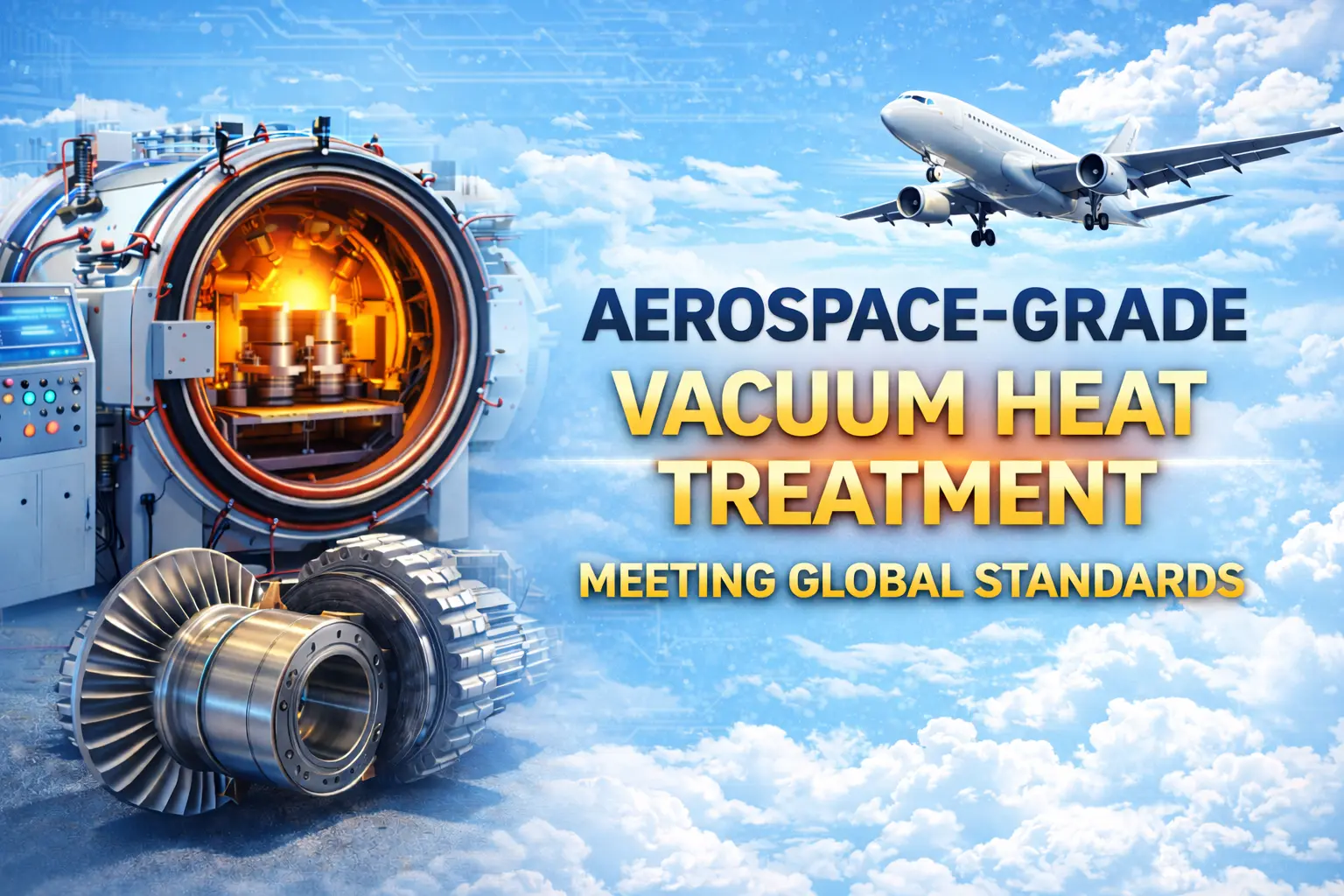
aerospace industry represents the pinnacle of engineering precision. Aircraft engines, structural components, landing gear systems, and turbine assemblies operate under extreme conditions—high temperatures, immense pressure, and repetitive stress cycles. In such an environment, material failure is not an option.
To ensure structural integrity, performance reliability, and global compliance, manufacturers rely on
Vacuum Heat Treatment . Aerospace-grade vacuum processing is not just about improving material properties—it is about meeting international standards, ensuring safety, and maintaining zero-defect manufacturing.
Why Aerospace Demands the Highest Standards
Aerospace components are exposed to some of the harshest operating conditions in any industry:
- Extreme temperature variations
- High mechanical loads
- Continuous fatigue cycles
- Corrosive atmospheric exposure
Unlike many industrial applications, aerospace parts must perform flawlessly for thousands of flight hours. Even microscopic surface contamination or minor metallurgical inconsistencies can compromise performance.
This is why
Vacuum Heat Treatment has become the preferred process for aerospace manufacturers worldwide. The oxygen-free environment ensures clean processing, while advanced furnace controls guarantee repeatability and precision.
What Is Aerospace-Grade Vacuum Heat Treatment?
Vacuum Heat Treatment is a controlled thermal process performed in a sealed chamber where air and reactive gases are removed. By eliminating oxygen and atmospheric contaminants, the process prevents:
- Oxidation
- Scaling
- Decarburization
- Surface contamination
In aerospace applications, this clean environment is critical—particularly when processing sensitive materials such as titanium and nickel-based superalloys.
Modern vacuum furnaces provide:
- Precise temperature uniformity
- Controlled heating and cooling rates
- Inert gas quenching
- Automated digital process monitoring
Aerospace Materials That Require Vacuum Heat Treatment
Aerospace engineering relies on high-performance alloys designed for strength, weight reduction, and temperature resistance. Common materials treated through
vacuum heat treatment services include:
-
Titanium Alloys:
Widely used in airframes and engine components due to their high strength-to-weight ratio and corrosion resistance. Titanium is highly reactive at elevated temperatures, making vacuum processing essential.
-
Nickel-Based Superalloys:
Used in turbine blades and high-temperature engine parts. These alloys require precise solution treatment and aging cycles to achieve optimal strength.
-
High-Strength Alloy Steels:
Common in landing gear and structural assemblies requiring fatigue resistance.
-
Tool Steels for Aerospace Tooling
Used in precision dies and manufacturing fixtures.
The versatility of Vacuum Heat Treatment Furnaces makes them suitable for both small batches and large-scale production requirements.
Processing these materials in a vacuum environment ensures microstructural stability and eliminates surface degradation.
Key Vacuum Heat Treatment Processes in Aerospace
-
Vacuum Hardening
Vacuum hardening enhances wear resistance and strength while minimizing distortion. Gas quenching provides controlled cooling, critical for maintaining dimensional accuracy in complex components.
-
Vacuum Annealing
Used to relieve internal stresses and improve ductility. Annealing is particularly important for parts that undergo machining or forming before final processing.
-
Solution Treatment and Aging
Commonly applied to aluminum and nickel-based alloys. This two-stage process strengthens the material through controlled precipitation hardening.
-
Vacuum Brazing
Used to join complex aerospace assemblies such as heat exchangers and honeycomb structures. The vacuum environment ensures clean, strong joints without flux residue.
Each of these processes requires strict parameter control to meet aerospace quality standards.
Global Aerospace Standards & Compliance
In aerospace manufacturing, certification and compliance are mandatory. Heat treatment providers must adhere to globally recognized standards such as:
-
NADCAP (National Aerospace and Defense Contractors Accreditation Program)
- AMS (Aerospace Material Specifications)
- AS9100 Quality Management Systems
These standards require:
- Detailed process documentation
- Temperature uniformity surveys (TUS)
- System accuracy tests (SAT)
- Complete batch traceability
- Calibration and validation records
Professional
vacuum heat treatment services providers invest heavily in monitoring systems and quality assurance to maintain compliance.
The Role of Advanced Heat Treatment Furnace Manufacturers
Aerospace-grade results depend heavily on furnace technology. Leading
heat treatment furnace manufacturers design systems capable of:
-
Maintaining precise temperature uniformity
- Supporting programmable heating cycles
- Ensuring controlled vacuum levels
- Delivering high-pressure gas quenching
- Integrating real-time digital monitoring
Modern furnaces are equipped with automated data logging and Industry 4.0 connectivity. This ensures full process traceability—an essential requirement for aerospace certification.
The collaboration between aerospace manufacturers and advanced furnace manufacturers plays a crucial role in achieving consistent, repeatable results.
Advantages of Vacuum Heat Treatment Services for Aerospace
Choosing specialized
vacuum heat treatment services offers several critical benefits:
-
Oxidation-Free Surface Finish
Eliminates scaling, reducing the need for post-processing.
-
Improved Fatigue Life
Clean surfaces and uniform microstructure enhance long-term durability.
-
Dimensional Stability
Controlled heating and cooling reduce distortion in precision components.
-
Repeatability
Used to join Ideal for high-volume aerospace production with consistent batch quality.
-
Compliance Support
Certified providers ensure adherence to global aerospace standards.
These advantages make vacuum processing indispensable for aerospace applications.
Challenges in Aerospace Heat Treatment — And How Vacuum Technology Solves Them
Choosing specialized
vacuum heat treatment services offers several critical benefits:
-
Material Sensitivity
Titanium and superalloys are highly reactive at elevated temperatures. Vacuum environments eliminate oxygen exposure.
-
Tight Tolerances
Gas quenching minimizes dimensional changes compared to oil quenching.
-
Contamination Risks
Vacuum chambers prevent atmospheric contamination.
-
Complex Geometries
Uniform heat distribution ensures consistent results across intricate designs.
Vacuum technology addresses these challenges effectively, ensuring high-performance output.
The Future of Aerospace Vacuum Heat Treatment
The aerospace industry continues to evolve with advancements in:
- Lightweight composite materials
- Advanced high-temperature alloys
- Electric and hybrid aircraft systems
- Sustainable aviation technologies
As aircraft engines become more efficient and operate at higher temperatures, the demand for advanced
Vacuum Heat Treatment processes will increase.
Future developments include:
- AI-driven furnace controls
- Enhanced automation
- Energy-efficient vacuum systems
- Real-time digital traceability
These innovations will further strengthen compliance and performance standards in aerospace manufacturing.
Conclusion
Aerospace engineering demands absolute precision, reliability, and compliance. Vacuum Heat Treatment provides the clean, controlled environment necessary to achieve superior metallurgical properties and meet stringent global standards.
From titanium airframe components to nickel-based turbine blades, aerospace-grade processing ensures strength, fatigue resistance, and dimensional stability. By partnering with experienced
vacuum heat treatment services providers equipped with advanced systems from leading
heat treatment furnace manufacturers, aerospace companies can confidently meet international certification requirements.
As global aviation and defense sectors expand, vacuum heat treatment will remain a cornerstone of aerospace manufacturing excellence—ensuring safety, performance, and reliability at every altitude.
✈ Precision Vacuum Heat Treatment for Aerospace Applications
Indo-German Vacu Treat Pvt. Ltd. (IGVT) delivers advanced Vacuum Heat Treatment solutions tailored for aerospace-grade components. With state-of-the-art vacuum furnaces, strict process control, and compliance-focused operations, IGVT supports manufacturers in meeting demanding global aerospace standards.
From titanium alloys and superalloys to high-strength steels, our certified vacuum heat treatment services ensure oxidation-free processing, controlled microstructures, and exceptional dimensional stability.
Backed by advanced systems from leading heat treatment furnace manufacturers, IGVT provides reliable, repeatable, and quality-assured solutions for aerospace OEMs and Tier suppliers.