Blog

Understanding Hardening, Tempering & Annealing in Vacuum Heat Treatment

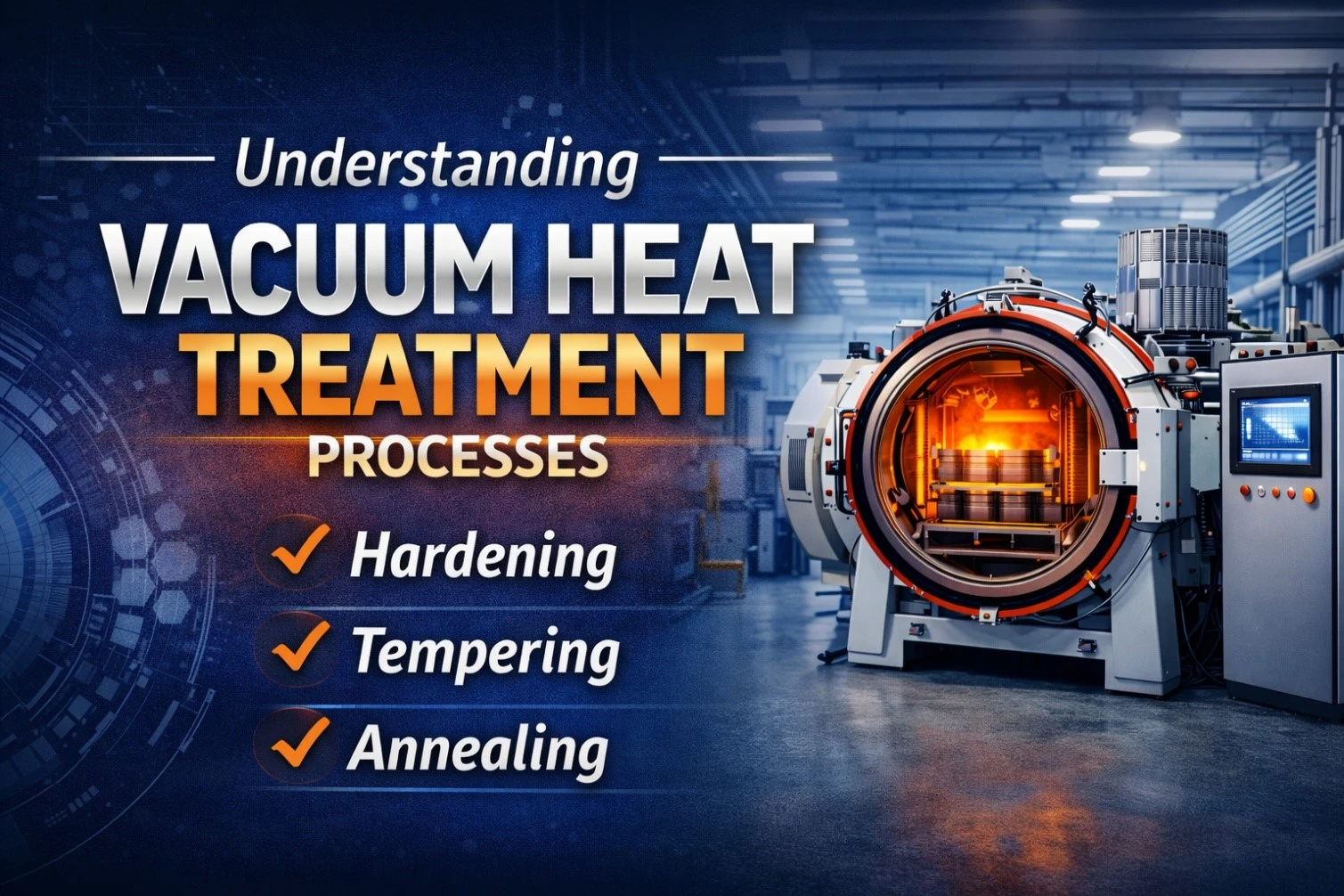
Understanding Vacuum Heat Treatment Processes
Heat treatment plays a critical role in enhancing the mechanical properties of metals used across modern manufacturing industries. Processes such as hardening, tempering, and annealing are essential for achieving the desired balance of strength, toughness, and durability. With increasing demand for precision and surface quality, vacuum heat treatment has become the preferred method over conventional atmospheric processes.
This blog provides a clear understanding of how hardening, tempering, and annealing work in vacuum heat treatment systems and why industries are rapidly adopting this advanced technology.

What Is Vacuum Heat Treatment?

Vacuum heat treatment is a controlled thermal process carried out in a vacuum environment to alter the physical and metallurgical properties of metals. Unlike traditional heat treatment, where components are exposed to air or reactive gases, vacuum processing eliminates oxygen from the furnace chamber. This prevents oxidation, scaling, and contamination during heating and cooling cycles.
By ensuring uniform temperature distribution and clean processing conditions, vacuum heat treatment delivers consistent results, minimal distortion, and superior surface finish—making it ideal for high-precision components.

Understanding Hardening in Vacuum Heat Treatment

What Is Hardening? Hardening is a heat treatment process designed to increase the hardness and wear resistance of metals, primarily steels. The material is heated to a specific temperature where its microstructure transforms and is then rapidly cooled to lock in hardness.
Vacuum Hardening Process In vacuum hardening, components are heated inside a vacuum furnace to precise austenitizing temperatures as per material grade. Once the desired temperature is achieved, rapid cooling is performed using high-pressure inert gases such as nitrogen. This controlled quenching method replaces traditional oil or water quenching.
Benefits of Vacuum Hardening
  • Uniform hardness throughout the component
  • Oxidation-free and clean surfaces
  • Reduced risk of distortion and crackinglife
  • Improved dimensional accuracy
Due to these advantages, manufacturers increasingly look for reliable local vacuum hardening service providers .

Understanding Tempering in Vacuum Heat Treatment

What Is Tempering? Tempering is a follow-up process performed after hardening. While hardening increases strength, it also makes the material brittle. Tempering reduces this brittleness while maintaining sufficient hardness and improving toughness.
Tempering in Vacuum Furnaces In vacuum tempering, hardened components are reheated to controlled temperatures in a vacuum environment. Precise temperature control ensures consistent stress relief without surface oxidation.
Benefits of Vacuum Tempering
  • Improved toughness and impact resistance
  • Enhanced fatigue life
  • Reduced internal stresses
  • Consistent mechanical properties
Vacuum tempering ensures that components perform reliably under dynamic and high-stress operating conditions.

Understanding Annealing in Vacuum Heat Treatment

What Is Annealing? Annealing is a heat treatment process used to soften metals, relieve internal stresses, and improve ductility. It is commonly applied before machining or forming operations.
Vacuum Annealing Process During vacuum annealing, components are heated slowly in a vacuum furnace and cooled in a controlled manner. The vacuum environment prevents surface oxidation, resulting in a bright and clean finish.
Benefits of Vacuum Annealing
  • Improved machinability
  • Enhanced ductility and formability
  • Stress relief without surface contamination
  • Uniform microstructure
Vacuum annealing is particularly beneficial for stainless steels and high-alloy materials where surface quality is critical.
Process Primary Purpose Key Outcome
Hardening Increase hardness and wear resistance High strength, hard surface
Tempering Reduce brittleness Improved toughness
Annealing Soften material and relieve stress Improved ductility

Applications Across Industries

Vacuum heat treatment processes such as hardening, tempering, and annealing are widely used in:
  • Tool & Die Manufacturing: punches, dies, molds
  • Automotive Industry: gears, shafts, transmission components
  • Aerospace & Defense: high-strength, fatigue-resistant parts
  • Medical Equipment: surgical instruments and implants
  • Industrial Machinery: wear-resistant mechanical components
The ability to deliver precise and repeatable results makes vacuum heat treatment essential for critical components.

Why Choose Vacuum Heat Treatment Over Conventional Methods?

Vacuum heat treatment offers several advantages over traditional atmospheric processes:
  • Oxidation-free processing
  • Superior surface finish
  • Minimal distortion
  • High repeatability and process control
  • Environmentally cleaner operations
These benefits lead to reduced rework, improved component performance, and longer service life.

Choosing the Right Vacuum Heat Treatment Service Provider

When selecting a vacuum heat treatment partner, manufacturers should consider:
  • • Availability of advanced vacuum furnaces
  • • Experience with different heat treatment processes
  • • Quality certifications and process controls
  • • Proximity to manufacturing locations
Searching for vacuum hardening near me helps manufacturers find service providers that offer faster turnaround times and consistent quality.

Conclusion

Understanding the roles of hardening, tempering, and annealing is essential for achieving optimal performance in metal components. When performed using vacuum heat treatment, these processes deliver superior precision, cleanliness, and reliability compared to conventional methods.
As industries demand higher quality and tighter tolerances, vacuum-based heat treatment solutions continue to gain importance. Partnering with a trusted vacuum heat treatment service provider ensures consistent results, improved productivity, and long-term manufacturing success.