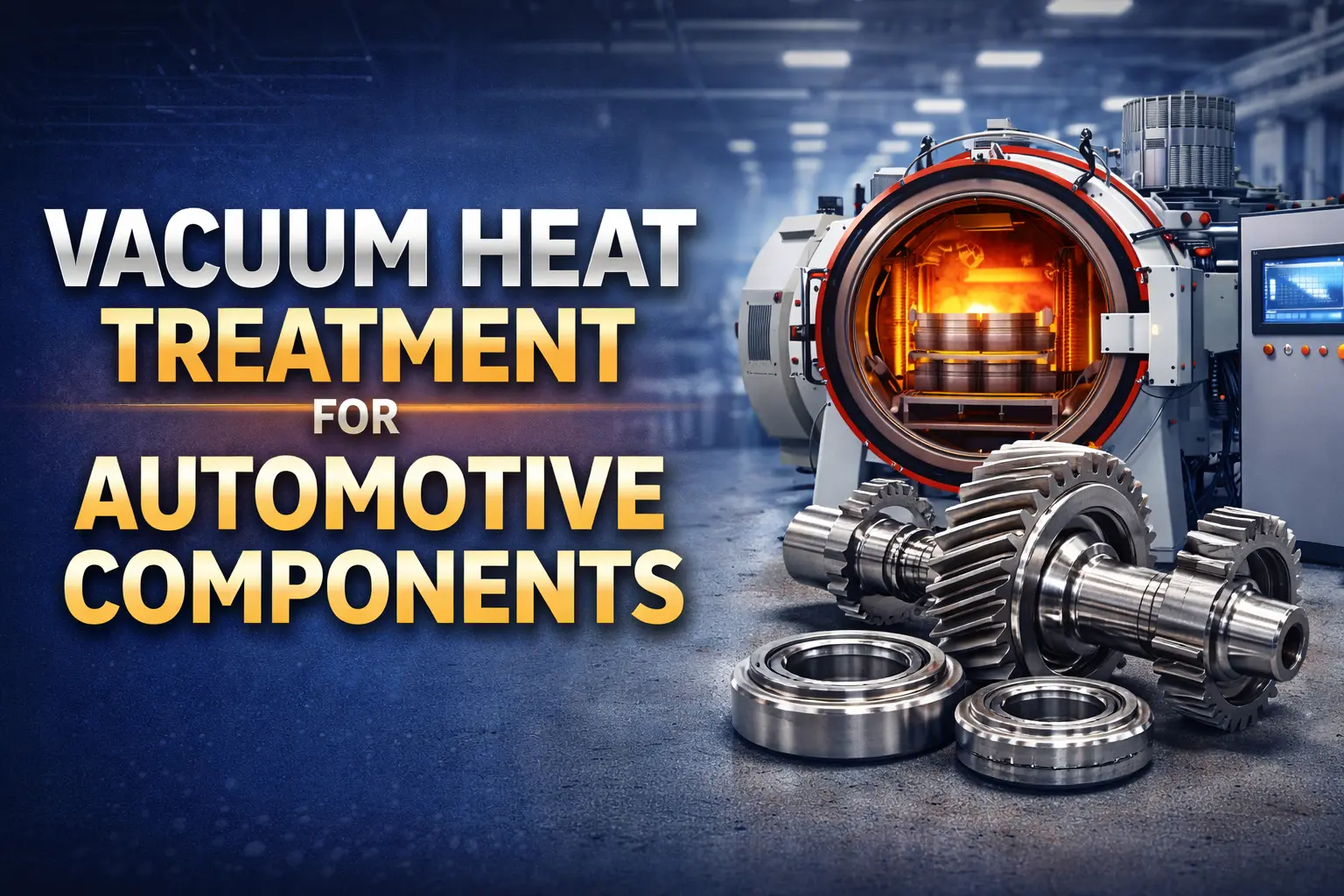
The
automotive industry operates in one of the most demanding engineering environments in the world. Components must withstand extreme temperatures, high rotational speeds, constant friction, and heavy loads — all while maintaining dimensional precision and long service life. To meet these rigorous standards, manufacturers increasingly rely on
Vacuum Heat Treatment for Automotive Components.
Unlike
conventional heat treatment methods , Vacuum Heat Treatment provides superior surface quality, consistent metallurgical properties, and minimal distortion. In an industry where precision and reliability are non-negotiable, advanced heat treatment technology plays a critical role.
The Importance of Precision in Automotive Manufacturing
Automotive components are designed to function under
high mechanical stress and continuous operational strain. Gears, shafts, engine parts, and transmission components must maintain strength and fatigue resistance over millions of cycles.
Even minor dimensional deviations can lead to vibration, noise, premature wear, or failure. This is why automotive manufacturers prioritize heat treatment processes that offer:
- Uniform hardness
- Controlled microstructure
- Minimal distortion
- High repeatability
Vacuum Heat Treatment for Automotive Components ensures these requirements are met consistently.
What Is Vacuum Heat Treatment?
Vacuum Heat Treatment is a controlled thermal process carried out inside a sealed vacuum furnace. By removing oxygen and atmospheric gases from the chamber, the process prevents oxidation, scaling, and surface contamination.
Key characteristics include:
- Oxygen-free heating environment
- Precise temperature control
- Controlled cooling using inert gases
- Clean and bright surface finish
Compared to conventional furnace methods, vacuum systems offer better process control, uniform heat distribution, and improved dimensional stability — all essential for automotive parts.
Why Automotive Components Require Advanced Heat Treatment
Automotive parts face unique performance challenges:
1.High Load & Stress
Transmission gears and shafts operate under continuous torque and load.
2.Friction & Wear
Moving components require high wear resistance to ensure durability.
3.Safety Requirements
Critical components must meet strict quality and safety standards.
4.Tight Tolerances
Modern automotive engineering demands micron-level precision.
Vacuum Heat Treatment enhances mechanical properties while preserving dimensional accuracy, making it ideal for these demanding applications.
Key Automotive Components Treated Using Vacuum Heat Treatment
-
Transmission gears
- Drive shafts
- Aerospace & Defense:
High-strength, fatigue-resistant components
- Camshafts
- Bearings
- Fuel system components
- Engine parts
- Tooling used in automotive production
Each of these components benefits from controlled hardening, improved fatigue strength, and clean surface integrity.
Core Processes Used in Automotive Vacuum Heat Treatment
Vacuum Hardening
Vacuum hardening increases hardness and wear resistance while reducing distortion. Instead of oil quenching, inert gas quenching ensures controlled cooling, minimizing dimensional changes.
Benefits
-
Uniform hardness
- Minimal cracking
- Scale-free surface
Vacuum Tempering
After hardening, tempering reduces brittleness while maintaining strength. Vacuum tempering ensures precise temperature regulation and consistent mechanical properties.
Benefits
- Improved toughness
- Enhanced fatigue resistance
- Better stress distribution
Vacuum Annealing
Annealing relieves internal stresses and improves machinability. In automotive manufacturing, this process is often used before further machining operations.
Benefits
- Improved ductility
- Stress relief
- Bright, oxidation-free surface
Vacuum Brazing
Used for joining complex assemblies such as heat exchangers and engine components, vacuum brazing ensures clean, strong joints without flux contamination.
Advantages of Commercial Vacuum Heat Treatment for Automotive Industry
Many automotive manufacturers rely on commercial vacuum heat treatment providers rather than in-house facilities. This approach offers several advantages:
1.Oxidation-Free Processing
No scaling or decarburization, ensuring superior surface quality.
2.Dimensional Stability
Reduced distortion minimizes rework and rejection rates.
3.Consistency & Repeatability
Ideal for high-volume production with consistent results.
4.Advanced Furnace Technology
Commercial providers use modern vacuum furnaces with automated process controls.
5.Cost Efficiency
Eliminates the need for heavy capital investment in specialized equipment.
By partnering with a
commercial vacuum heat treatment provider , automotive manufacturers gain access to advanced technology and metallurgical expertise.
Compliance & Quality Standards in Automotive Heat Treatment
The automotive sector operates under strict quality standards.
Heat treatment processes must ensure:
-
Traceability of batches
- Controlled process parameters
- Documentation and testing reports
- Compliance with OEM and Tier-1 supplier requirements
Vacuum systems provide enhanced monitoring and digital process control, supporting these compliance requirements effectively.
Why Automotive Manufacturers Prefer Commercial Vacuum Heat Treatment Providers
Automotive companies increasingly choose commercial service providers because they offer:
-
Large-capacity vacuum furnaces
- Expertise in various steel grades
- Certified quality management systems
- Faster turnaround timesmanufacturing
- Multi-location support for logistics efficiency
This allows manufacturers to focus on production while relying on specialized
heat treatment experts .
Future Trends in Automotive Heat Treatment
The evolution of the automotive industry — especially with the rise of electric vehicles (EVs) — is increasing the demand for precision-engineered components.
Emerging trends include:
-
Lightweight high-strength alloys
- EV motor shaft and gear components
- Automation in furnace monitoring
- Digital process traceability
- Sustainable and energy-efficient processing
As vehicles become more advanced, the role of Vacuum Heat Treatment for Automotive Components will continue to grow.
Conclusion
In today’s automotive landscape, performance, reliability, and precision are critical. Vacuum Heat Treatment offers superior control, cleaner processing, and enhanced mechanical properties compared to conventional methods.
From gears and shafts to engine and transmission components,
Vacuum Heat Treatment for Automotive Components ensures durability, safety, and long-term operational efficiency. By partnering with an experienced
commercial vacuum heat treatment provider, automotive manufacturers can achieve consistent quality, reduced distortion, and improved productivity.
As the industry moves toward greater innovation and electrification, vacuum-based heat treatment will remain a cornerstone of automotive manufacturing excellence.
Indo-German Vacu Treat Pvt. Ltd. (IGVT) delivers advanced
Vacuum Heat Treatment for Automotive Components using state-of-the-art vacuum furnaces and globally proven metallurgical processes.
From gears and shafts to high-performance engine components, IGVT ensures oxidation-free processing, minimal distortion, and consistent mechanical properties.
As a
trusted commercial vacuum heat treatment partner, IGVT supports OEMs and Tier-1 automotive manufacturers with precision-driven, reliable, and scalable heat treatment solutions.