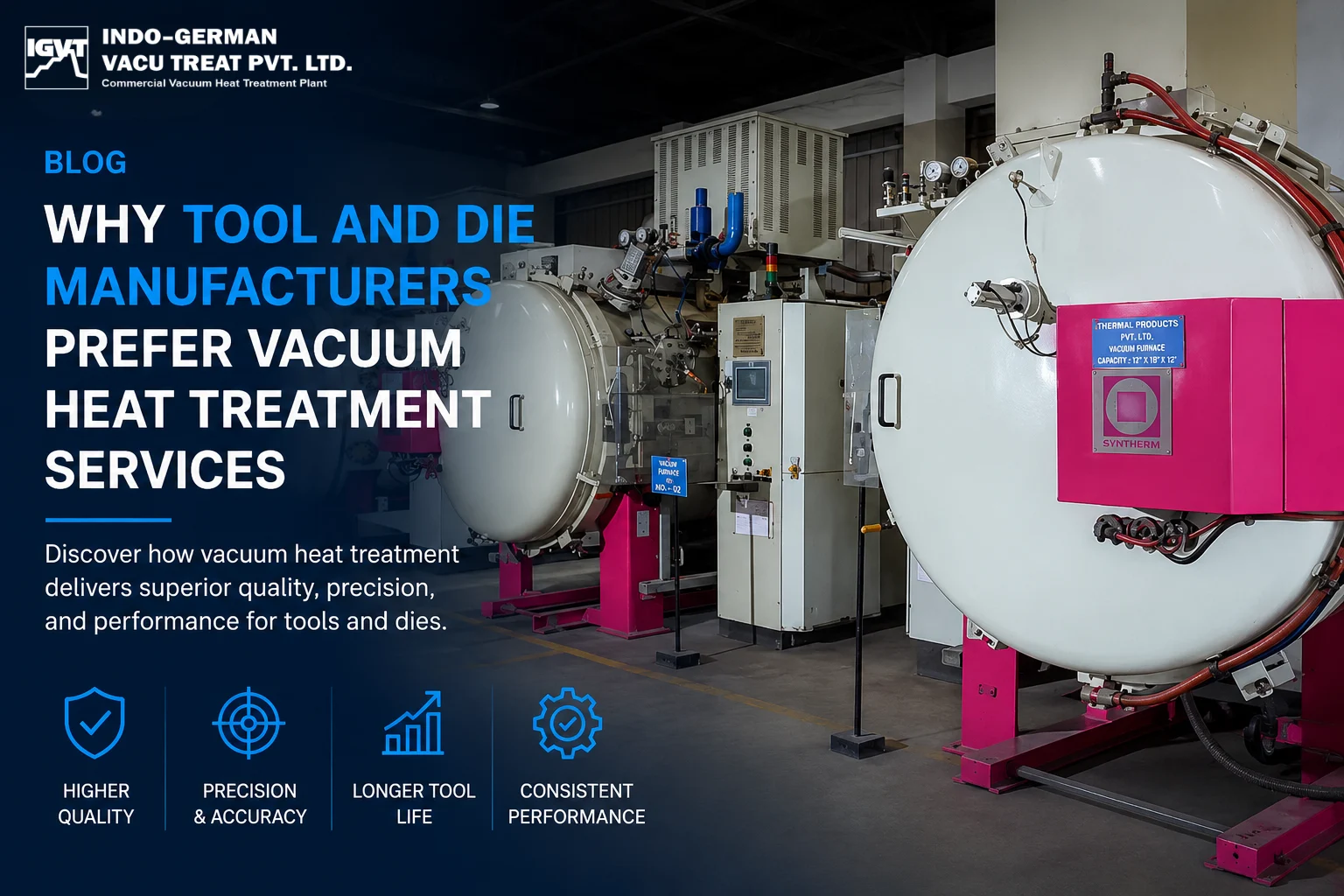
Blog

Why Tool & Die Manufacturers Prefer Vacuum Heat Treatment Services

Why-Tool-Die-Manufacturers-Prefer-Vacuum-Heat-Treatment-Services
Tool and die manufacturing is the backbone of precision engineering across industries such as automotive, aerospace, and consumer goods. These tools must deliver consistent performance under high pressure, temperature, and wear conditions. Achieving the required hardness, durability, and dimensional accuracy is critical—and this is where vacuum heat treatment services play a vital role..
Compared to conventional heat treatment methods, vacuum technology offers superior control, cleaner processing, and highly consistent results, making it the preferred choice for tool and die manufacturers.

What Is Vacuum Heat Treatment?

Vacuum heat treatment is a controlled process carried out in an oxygen-free environment using advanced Vacuum Heat Treatment Furnaces. By eliminating air and reactive gases, the process prevents oxidation, scaling, and contamination.
Unlike traditional methods, vacuum systems ensure:
  • Uniform temperature distribution
  • Precise process control
  • Clean and bright surface finish
  • Minimal distortion
These benefits are especially important for tools and dies that require tight tolerances and high performance.

Challenges Faced by Tool & Die Manufacturers

Tool and die manufacturers often face several issues with conventional heat treatment:
  • Distortion and dimensional changes affecting precision
  • Surface oxidation and scaling leading to additional finishing work
  • Inconsistent hardness across components
  • Increased rework and rejection rates
These challenges directly impact production efficiency, cost, and product quality.

Why Tool & Die Manufacturers Prefer Vacuum Heat Treatment Services

1.Superior Surface Finish

Vacuum processing eliminates oxidation, resulting in clean, scale-free surfaces. This reduces the need for post-treatment machining or polishing

2.Minimal Distortion

Controlled heating and cooling cycles ensure dimensional stability. This is crucial for precision dies and molds where even slight distortion can affect performance.

3.Consistent Hardness

Advanced Vacuum Heat Treatment Furnaces provide uniform heating, ensuring consistent hardness across the entire component.

4.Improved Tool Life

Vacuum heat treatment enhances wear resistance, increasing the lifespan of tools and reducing replacement frequency.

5.High Repeatability

For manufacturers producing tools in batches,vacuum heat treatment services ensure consistent results every time.

Role of Advanced Vacuum Heat Treatment Furnacesv

The performance of vacuum heat treatment largely depends on furnace technology. Modern furnaces designed by leading vacuum heat treatment furnace manufacturers in India and global heat treatment furnace manufacturers offer:
  • Precise temperature control
  • High vacuum levels
  • Advanced gas quenching systems
  • Automated process monitoring
These innovations enable manufacturers to achieve high-quality, repeatable results required for tool and die applications.

Key Processes Used for Tools & Dies

1.Vacuum Hardening

Enhances hardness and wear resistance while maintaining dimensional stability.

2.Vacuum Tempering

Reduces brittleness and improves toughness after hardening.

3.Vacuum Annealing

Relieves internal stresses and improves machinability.

4.Sub-Zero / Cryogenic Treatment

Enhances wear resistance and dimensional stability by refining microstructure.
Together, these processes optimize the performance and longevity of tools and dies.

Advantages of Commercial Vacuum Heat Treatment

Many manufacturers prefer commercial vacuum heat treatment services instead of investing in in-house facilities.

Key benefits include:

  • Access to advanced furnace technology
  • Lower capital investment
  • Expert metallurgical support
  • Faster turnaround time
  • Scalability for different production volumes
These innovations improve process accuracy, repeatability, and sustainability.

Choosing the Right Vacuum Heat Treatment Partner

Selecting the right service provider is crucial for achieving consistent quality. Manufacturers should consider:
  • Furnace capabilities and technology
  • Experience in handling tool steels
  • Quality certifications and process control
  • Reliability and turnaround time
Partnering with a trusted provider ensures long-term performance and productivity.

Conclusion

For tool and die manufacturers, precision, durability, and consistency are non-negotiable. Vacuum heat treatment services offer a clear advantage by delivering oxidation-free surfaces, minimal distortion, and superior metallurgical properties.
With advanced Vacuum Heat Treatment Furnaces and support from experienced heat treatment furnace manufacturers, vacuum technology has become the preferred choice for modern tooling applications. By adopting commercial vacuum heat treatment, manufacturers can enhance tool performance, reduce costs, and improve overall production efficiency.

FAQs

1.What is vacuum heat treatment and why is it used for tools and dies?

Vacuum heat treatment is a process carried out in an oxygen-free environment to improve metal properties. It is used for tools and dies to achieve high hardness, precision, and clean surfaces without oxidation.

2.How does vacuum heat treatment improve tool life?

It enhances wear resistance and reduces surface defects, allowing tools to perform longer under high stress and friction conditions.

3.What are Vacuum Heat Treatment Furnaces?

These are specialized furnaces designed to operate in a vacuum environment, ensuring controlled heating, clean processing, and consistent metallurgical results.

4.Why choose commercial vacuum heat treatment services?

Commercial services provide access to advanced technology, expert knowledge, and cost-effective solutions without the need for heavy investment in equipment.

5.How do I select the right vacuum heat treatment provider?

Look for providers with advanced furnace technology, industry experience, quality certifications, and a proven track record in tool and die applications.